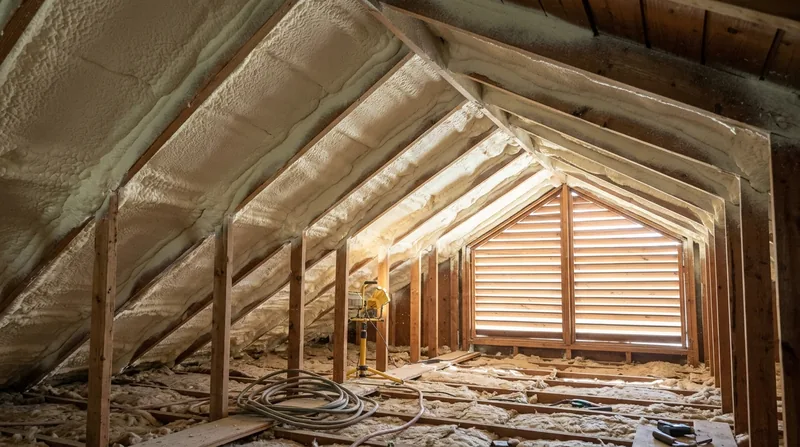




Attic spray foam insulation in Evansville transforms a hot, leaky attic into a conditioned space that holds steady through the Ohio River's brutal humidity swings and winter ice. Evansville attics sit in IECC climate zone 4A, mixed humid, where summer heat pushes 90+ degrees under the roof deck while winter cold snaps and ice dams test the other direction. The older wood-frame homes clustered near Haynie's Corner and the Riverside, plus mid-century ranches scattered across Vanderburgh County, carry original vented attics with flattened insulation and no air sealing at the rim joist. Newer two-story homes pushing east toward Newburgh and Darmstadt have larger attic volumes that drive summer cooling bills hard. Spray foam applied directly to the roof deck stops that two-way vapor drive, seals every air leak at the top plate and band joist, and keeps your living space comfortable year-round without the seasonal swings that drive energy costs up and moisture into crawl spaces and basements. We have served Evansville homeowners and builders since 2013 with written estimates that specify R-value and thickness, controlled application, and honest guidance on whether spray foam or a simpler approach is the right answer for your attic.
Why Attic Spray Foam Insulation Matters in Evansville's Hot Summers and Cold Winters
Evansville's climate creates a unique challenge: the same attic that bakes at 140+ degrees in July has to shed moisture and ice in January. A vented attic with conventional insulation leaves air gaps at the top plate, around ductwork penetrations, and at the rim joist where the second floor meets the foundation. That means conditioned air escapes in winter, humid outside air leaks in during summer, and your HVAC system works harder every season. Spray foam seals those gaps, stops air infiltration, and when applied to the roof deck, creates an unvented or sealed attic that becomes part of your conditioned envelope. The result is steadier indoor temperature, lower utility bills, and no more moisture pooling in crawl spaces after a humid night or a river flood event.
- We spray closed-cell or open-cell foam directly to the underside of your roof deck to create an air-tight thermal barrier.
- Sealing the attic stops hot air from rising and escaping in summer, and cold air from sinking through the top plate in winter.
- Foam fills every cavity, corner, and penetration where fiberglass leaves gaps and moisture can move.
- A sealed attic keeps your ductwork and HVAC equipment in a conditioned zone, so they run more efficiently.
- The air seal at the rim joist and band joist stops humid air from rising into the attic from the crawl space or basement below.
Getting attic spray foam insulation right means understanding your local building code, your HVAC setup, and whether your roof deck can handle the weight and vapor dynamics of a sealed system.
Key info: Evansville and surrounding areas sit in a mixed-humid climate where both summer moisture infiltration and winter condensation risk are real. Sealed attics with spray foam are the standard retrofit for this zone because they stop the two-way vapor drive that damages fiberglass and drives moisture into crawl spaces. Your local building department may require a vapor-permeable membrane or specific ventilation details, so we always verify code requirements before we spray.
For more on how spray foam seals air leaks throughout your home, see our air sealing service page.
How We Install Attic Spray Foam Insulation in Evansville: Step-by-Step
Our process starts with a site visit to measure your attic volume, identify air leaks at the rim joist and band joist, check roof deck condition, and confirm what your local building code requires. We give you a written estimate that specifies the R-value you will receive, the foam thickness in inches, and the total square footage we will cover. On the day of installation, we set up mechanical ventilation to manage cure fumes, protect your belongings and HVAC equipment with plastic sheeting, and spray the foam in controlled passes to the correct thickness. We follow the manufacturer's drum temperature and mix ratio exactly, and we observe the re-entry window your building code requires (typically 24 to 48 hours) before you use the attic or turn on your HVAC system.
- We inspect your attic for moisture, leaks, or contamination and address any issues before we spray.
- We seal all penetrations, ductwork, and electrical boxes with foam to stop air leakage at the thermal boundary.
- We apply foam to the correct thickness in a single or multiple passes, depending on your R-value target and the foam type.
- We run mechanical ventilation during cure and leave the space undisturbed for the full re-entry window.
- We remove protective sheeting and walk you through what to expect during cure and how to verify your installation.
A typical attic job in a Evansville ranch or two-story home takes one to two days from start to finish, depending on square footage and complexity.
Example: A 1,500-square-foot sealed attic in a mid-century ranch near Darmstadt with a vented soffit and rim joist air leaks typically gets 5 to 6 inches of closed-cell foam for an R-value of R-30 to R-36. We seal the rim joist, top plate, and all penetrations, then spray the roof deck. The job takes one day, and you can re-enter the attic after 48 hours.
For details on the two main foam types and when to use each, see our closed-cell spray foam and open-cell spray foam service pages.
Attic Spray Foam Insulation Methods: Closed-Cell vs. Open-Cell
| Approach | Description | Best for |
|---|---|---|
| Closed-Cell Spray Foam | Dense, rigid foam with a vapor barrier. R-value 6.5 to 7.0 per inch. Resists moisture and provides structural support. | Sealed attics in mixed-humid climates where moisture control and condensation prevention are critical. Evansville's two-way vapor drive makes this the standard choice for retrofit attics. |
| Open-Cell Spray Foam | Softer, more flexible foam. R-value 3.5 to 3.8 per inch. Vapor-permeable; allows drying to the interior. | Vented attics or retrofit jobs where you want sound dampening and lower cost. Requires thicker application (8 to 10 inches for R-30) and proper ventilation to manage moisture. |
| Rim Joist and Band Joist Sealing | Closed-cell foam applied to the rim joist and band joist to stop air infiltration and moisture from crawl spaces or basements. | Every Evansville attic retrofit. The rim joist is where humid air from below enters the attic and where cold air leaks out in winter. Sealing it is non-negotiable for comfort and energy savings. |
| Insulation Removal and Replacement | We remove failed or contaminated fiberglass, cellulose, or old foam, then install new spray foam or blown-in insulation. | Attics with flattened, wet, or moldy insulation. Removal and replacement is the precondition of every retrofit; we never spray over a compromised substrate. |
Each method has a place, and the right choice depends on your attic's current condition, your budget, and your local building code. We help you understand the trade-offs and pick the approach that delivers the best performance for your home.
Attic Spray Foam Insulation Cost in Evansville: What to Expect
Attic spray foam insulation pricing in Evansville typically starts at $1.50 per square foot for open-cell foam in a straightforward retrofit, and $2.00 to $3.00 per square foot for closed-cell foam, which is the standard for sealed attics in our mixed-humid climate. The total cost depends on your attic square footage, the R-value target, foam type, access difficulty, whether you need old insulation removed first, and how many air leaks and penetrations we have to seal. A 1,500-square-foot attic with rim joist sealing and a full closed-cell retrofit typically runs $3,000 to $5,500; a smaller 800-square-foot attic with open-cell foam runs $1,200 to $2,000. Jobs that require extensive removal of failed insulation, structural repairs, or difficult access cost more. We always give you a written estimate with R-value, thickness, and total square footage so you know exactly what you are paying for.
- Get 2 to 3 estimates from local contractors so you can compare R-value, thickness, foam type, and warranty terms side by side.
- Ask each contractor whether their price includes rim joist sealing, old insulation removal, and mechanical ventilation during cure.
- Verify that the estimate specifies R-value in numbers, not vague language like "high-performance" or "premium grade".
- Watch for prices far below market or estimates with no thickness or R-value specified; that is a sign of a rig-and-run operation.
- Ask whether the price covers a thermal barrier or ignition barrier if your code requires one; that adds cost and must be named upfront.
Your attic is one of the highest-ROI home efficiency upgrades you can make in Evansville. For a full breakdown of pricing and what factors move the cost up or down, see our pricing overview.
Attic Spray Foam Insulation Near Me: What to Look for When Hiring a Contractor in Evansville
Finding the right spray foam contractor near Evansville means understanding the difference between a local, independent shop and a rig-and-run crew or national franchise. A good contractor will give you a written estimate with R-value and thickness, explain the difference between closed-cell and open-cell foam in plain language, and tell you honestly when a simpler insulation approach is the right answer. They will run mechanical ventilation during cure, observe the re-entry window your code requires, and be reachable if questions come up after the job. They should be fully insured and able to show proof of coverage. They will also know your local building code and whether your attic retrofit requires a thermal barrier, an ignition barrier, or specific ventilation details.
- Verify that the contractor is fully insured and can provide a certificate of insurance before work starts.
- Ask for references from recent attic spray foam jobs in Evansville or nearby towns like Newburgh, Chandler, or Darmstadt.
- Confirm that the contractor will handle permitting or will clearly explain what permits you need to pull and with which city department.
- Check whether the contractor knows your local building code and can explain thermal barrier and ignition barrier requirements for spray foam.
- Get a timeline in writing and ask what the re-entry window is; if they promise you can use the attic in 24 hours, walk away.
- Ask whether old insulation removal is included or quoted separately, and whether the contractor will dispose of it properly.
The spray foam trade has its share of shortcuts and fly-by-night operators, so doing your homework upfront protects your home and your wallet. Contact us for a free, no-obligation estimate, and we will walk you through exactly what your attic needs and why.
Attic Spray Foam Insulation in Evansville: Pricing Guide
| Service | Price | Details |
|---|---|---|
| Open-Cell Spray Foam Attic | Starting at $1.50/sq ft | Lower cost option for vented attics or sound dampening; requires 8 to 10 inches for R-30 coverage |
| Closed-Cell Spray Foam Attic (Sealed) | Starting at $2.00/sq ft | Standard retrofit for Evansville's mixed-humid climate; vapor-resistant, 5 to 6 inches achieves R-30 to R-36 |
| Rim Joist and Band Joist Sealing | Starting at $3.50/linear foot | Closed-cell foam applied to stop air and moisture infiltration from crawl spaces; typically 50 to 150 linear feet |
| Insulation Removal and Replacement | On estimate | Cost depends on volume of failed or contaminated insulation, disposal method, and substrate repair needed before new foam |
| Travel | Included | No separate call-out or mileage fee within Evansville and surrounding service areas |
| Free Estimate | No charge | Response within 24 hours at (930) 212-3276; written estimate with R-value, thickness, and total square footage |
Indicative pricing, the exact cost depends on square footage, finish, and site access. Free personalized estimate within 24h at (930) 212-3276.


