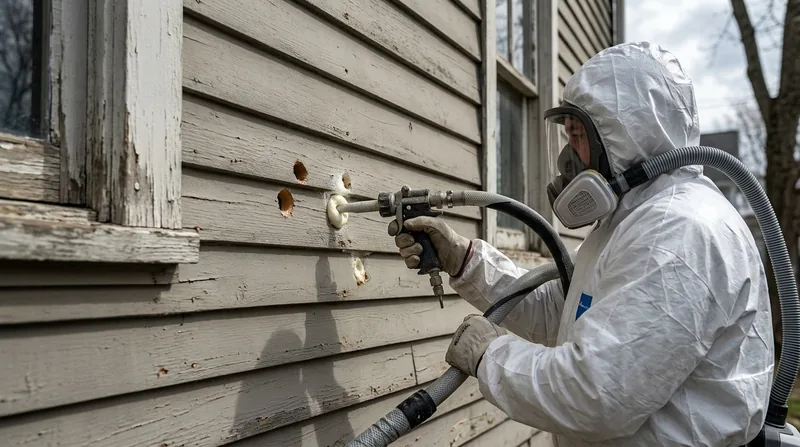




Wall & Injection Foam Insulation in Evansville fills the empty cavities inside wood-frame walls without opening drywall, making it the practical retrofit choice for older homes across Haynie's Corner, Riverside, and the neighborhoods built before modern subdivisions pushed toward Newburgh and Darmstadt. Evansville's pre-1980 housing stock, much of it built with uninsulated wall cavities, sits in IECC climate zone 4A, where hot, humid summers push moisture inward and cold winters reverse that pattern, creating a two-way vapor drive that drafts and energy loss exploit year-round. Injection foam seals those cavities from the inside, eliminating the thermal short-circuit and the air leakage that costs money every heating and cooling season. Unlike attic work or crawl space sealing, wall injection is invisible once complete, requires no drywall demolition, and delivers measurable comfort and efficiency gains in homes that have lost their original insulation to settling or were never insulated at all. We help homeowners across Greater Evansville understand whether injection foam, blown-in fiberglass, or a combination of methods makes sense for their specific walls and budget.
Why Wall & Injection Foam Insulation Matters in Evansville's Older Wood-Frame Homes
Evansville's wood-frame housing stock from the 1950s through the 1970s was often built with empty wall cavities or with insulation that has settled and compacted over decades. The combination of hot, humid summers and cold winters in zone 4A means those empty cavities are a direct path for conditioned air to escape and outside moisture to enter. Winter drafts around outlets and baseboards, summer cooling that never reaches the rooms farthest from the HVAC, and damp basement walls after heavy rain on the Ohio River are all signatures of uninsulated or poorly insulated walls. Injection foam fills those cavities completely, stops air movement, and controls moisture without requiring you to tear open drywall or disturb plaster in Haynie's Corner Victorians or mid-century ranches across Vanderburgh County.
- We identify empty cavities using thermal imaging and moisture meters before any work begins.
- We inject low-pressure foam into wall cavities from the exterior or interior, depending on access and the wall assembly.
- We verify fill density and thickness to meet code R-value requirements for your home's location and age.
- We seal all injection ports and restore exterior cladding or interior trim to original condition.
- The work is complete in one to two days for a typical Evansville home, with no interior disruption.
Wall injection foam is especially valuable in homes where drywall damage or historic preservation concerns make traditional insulation removal and replacement impractical.
Key info: Evansville's building code, governed by the local building department, sets thermal barrier and ignition barrier requirements for foam in walls. Always verify what applies to your address before starting work. Your local building department can tell you what is required.
For more detail on how air sealing complements wall insulation, see our air sealing service page.
How We Perform Wall & Injection Foam Insulation in Evansville Homes
Wall injection foam begins with a detailed inspection. We use thermal imaging and moisture measurement to identify which cavities are empty or under-filled, which walls face the most exposure, and whether the substrate is clean and dry. Wet, contaminated, or leaking walls are not candidates for foam, and we say so plainly. If moisture or structural issues are present, we address those first or we walk away. Once the wall is ready, we drill small access holes (typically 1 to 1.5 inches) into the rim band, rim joist, or stud cavity from the exterior or interior, inject foam at controlled pressure and temperature, and monitor fill density as the material expands. After cure, we plug the access holes, caulk, and restore the wall to its original appearance.
- We perform a thermal and moisture survey to confirm the wall cavity is empty and dry before any injection.
- We drill access holes in a staggered pattern to ensure complete fill without over-pressurizing the cavity.
- We inject foam at the manufacturer's specified ratio and temperature, controlling pressure to prevent cavity damage.
- We allow 24 to 48 hours cure time and maintain mechanical ventilation during application and early cure.
- We plug all access holes with foam, sand smooth, and finish with paint or caulk to match the existing wall.
A typical Evansville home with 1,500 to 2,000 square feet of wall cavity needing injection takes one to two days, with minimal interior access required.
Local example: A 1960s ranch in Highland with uninsulated rim joists and rim band heat loss in winter benefits from closed-cell injection foam in the rim cavity, combined with injection into the exterior wall cavities above. The total project seals the thermal envelope and typically costs less than removing and replacing blown-in fiberglass in the attic alone, making it a smart entry point for older-home retrofits.
Learn more about how closed-cell spray foam performs in wall cavities and rim joist applications.
Wall & Injection Foam Insulation Methods and Applications
| Approach | Description | Best for |
|---|---|---|
| Closed-Cell Injection Foam | High-density foam (3.5 to 4 lb/cu ft) injected into cavities. Provides R-value of 6.0 to 6.5 per inch, excellent air and moisture control, and structural reinforcement. | Rim joists, band joists, exterior walls in zone 4A, and any cavity where moisture control and thermal performance are priorities. |
| Open-Cell Injection Foam | Lower-density foam (0.5 to 1.5 lb/cu ft) injected into cavities. Provides R-value of 3.5 to 3.8 per inch, allows vapor transmission, and is less expensive than closed-cell. | Interior wall cavities in climate-controlled spaces where vapor permeability is acceptable and cost is a primary factor. |
| Rim & Band Joist Injection | Closed-cell foam injected into the cavity between the rim joist and the sill plate, sealing the thermal and air boundary at the foundation line. | Mid-century ranches and older Evansville homes where rim joist heat loss drives winter drafts and ice dams. Often combined with crawl space work. |
| Exterior Wall Cavity Fill | Injection into stud cavities from the exterior, typically in homes with wood siding or brick veneer. Holes are drilled between studs, foam injected, and cladding restored. | Historic homes in Haynie's Corner and Riverside where drywall removal is not an option. Preserves interior finishes and eliminates interior access. |
Each method is chosen based on the wall assembly, the climate exposure, moisture risk, and whether the work is visible from inside or outside the home. We specify R-value and thickness in writing before starting any job.
Wall & Injection Foam Insulation Cost in Evansville: What to Expect
Wall injection foam in Evansville typically starts at $2.00 per square foot of wall cavity area, with most homes falling between $1,800 and $4,500 for a complete retrofit. The actual cost depends on several concrete factors: the total cavity area needing fill, whether access is from the exterior (faster, often cheaper) or interior (may require more careful finish work), the type of foam selected (closed-cell is higher performance and higher cost; open-cell is less expensive), and the complexity of the wall assembly. A 1,500-square-foot ranch with uninsulated rim joists and exterior walls might cost $2,200 to $3,200. A larger two-story home with more linear footage of rim band and multiple exterior exposures could run $3,500 to $5,000 or more. The best way to know is to request a free estimate from a local contractor who will inspect the walls in person and provide a written quote with R-value and thickness specifications.
Several factors move the price within that range:
- Cavity size and accessibility determine the number of injection points needed and how quickly the work can be completed.
- Exterior cladding type (wood siding, brick, fiber cement) affects how access holes are drilled and restored.
- Closed-cell foam costs more per board foot than open-cell but delivers higher R-value and better moisture control.
- Seasonal demand and travel distance within Evansville and surrounding areas can affect scheduling but not price per square foot.
- Permit requirements vary by city, and some municipalities require inspection; your local building department can tell you what is required.
Always get 2 to 3 written estimates that specify R-value, foam type, and thickness. Be wary of quotes with no R-value specification, no mention of foam type, or prices far below market with no detail. For a complete pricing overview and to schedule a free estimate, visit our pricing page or call us at (930) 212-3276.
Wall & Injection Foam Insulation Near Me: What Evansville Homeowners Should Know When Hiring a Contractor
Choosing the right contractor for wall injection foam is as important as choosing the foam type itself. The spray foam industry includes local, independent shops with roots in the community, national franchises with regional crews, and out-of-state rig-and-run operations that spray a job in an afternoon and disappear when the smell won't go away or a problem surfaces weeks later. The local independent contractor is accountable, carries verifiable insurance, can be reached if questions arise after the work, and will stand behind the installation. Here's what to verify when comparing contractors in Evansville, Newburgh, Chandler, Highland, and surrounding areas.
- Verify that the contractor carries full insurance coverage, including general liability and workers' compensation, and ask for a certificate of insurance.
- Request written estimates that specify foam type, R-value, thickness in inches, and the total board feet to be injected.
- Ask for references from recent jobs in Evansville or nearby towns and follow up with at least two homeowners to ask about the work quality and the contractor's responsiveness.
- Confirm that the contractor understands your local building code and will help you navigate any permits or inspections required by your city or town.
- Verify that the contractor uses manufacturer-approved equipment, maintains proper drum temperature and ratio, and provides mechanical ventilation during application and cure.
- Ask about the re-entry window (typically 24 to 48 hours) and what to expect in terms of odor and off-gassing during cure.
A contractor who takes time to inspect your walls, answers your questions clearly, and provides a detailed written estimate is one you can trust. Contact us for a free, no-obligation estimate at our contact page or call (930) 212-3276 to discuss your walls and your goals.
Wall & Injection Foam Insulation in Evansville: Pricing Guide
| Service | Price | Details |
|---|---|---|
| Wall Injection Foam (Closed-Cell) | Starting at $2.00/sq ft | Price includes inspection, injection into cavities, access hole plugging, and exterior finish restoration. Actual cost depends on total cavity area and access method. |
| Rim Joist & Band Joist Injection | Starting at $1.50/linear ft | Seals the thermal boundary at the foundation line. Cost varies with joist depth, whether work is interior or exterior, and the linear footage of rim to be sealed. |
| Multi-Story or Complex Wall Assembly | On estimate | Homes with multiple wall exposures, difficult access, or mixed insulation scenarios require on-site inspection before a firm price is quoted. |
| Travel & Mobilization | Included | No separate travel fee or mileage charge within Evansville and surrounding service areas in Vanderburgh, Gibson, Spencer, Posey, Dubois, Pike and Warrick counties. |
| Free Estimate | No charge | Response within 24 hours at (930) 212-3276. Includes thermal imaging, moisture check, and written quote with R-value and thickness specifications. |
Indicative pricing, the exact cost depends on square footage, finish, and site access. Free personalized estimate within 24h at (930) 212-3276.


