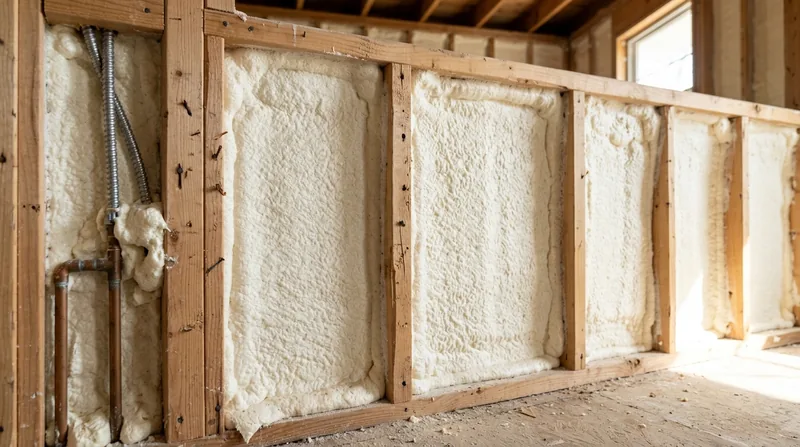




Open Cell Spray Foam Insulation in Evansville addresses the core energy leak in mid-century ranches scattered across Vanderburgh County: uninsulated stud bays in exterior walls that let humid summer air push moisture inward, and cold winter air seep in the opposite direction. Evansville sits in IECC climate zone 4A, mixed humid, where the Ohio River valley drives two-way vapor pressure through walls and crawl spaces year-round. Open cell foam expands to fill those cavities completely, sealing air leaks and muffling sound without the rigidity that closed cell brings to damp basements. It costs less per board foot than closed cell, makes sense for interior walls and attics where moisture control is not the primary driver, and installs faster. We help homeowners and builders in Evansville, Newburgh, Chandler, Highland, Darmstadt, and surrounding areas understand when open cell is the right choice and when closed cell or blown-in fiberglass is smarter.
Why Open Cell Spray Foam Matters in Evansville's Mixed-Humid Climate
Mid-century ranches across Vanderburgh County were built with wood-frame walls and minimal insulation. Those cavities stayed empty or were filled with kraft-faced fiberglass that has since settled, compressed, or failed. In Evansville's mixed-humid climate, the failure mode is not one-way vapor drive but two-way: humid air pushes in during summer, then reverses in winter, so the wall cavity sees pressure from both sides. Open cell foam seals the stud cavity completely, stops that two-way air leakage, and lets the wall dry if moisture does get in, because open cell is vapor-permeable. For interior walls in homes where the primary goal is air sealing and sound dampening, not condensation control on metal or concrete, open cell delivers.
- Fills stud bays completely without gaps or voids, stopping air leakage that drives heating and cooling loss.
- Expands to roughly 3.6 pounds per cubic foot (open cell density), enough to seal but soft enough to allow drying.
- Costs 30 to 50 percent less per board foot than closed cell, making full-wall retrofit more affordable.
- Deadens sound transmission through walls, a real benefit in older homes with thin plaster or drywall.
- Does not require a vapor barrier on the interior side in Evansville's climate, simplifying the install.
When the goal is sealing interior walls and attics without a tight moisture control layer, open cell is the right tool.
Key info: Evansville's two-way vapor drive in mixed-humid climate means walls need to breathe. Open cell foam stops air leakage while allowing drying, so moisture that enters the cavity can escape. Closed cell, by contrast, acts as a vapor barrier and is reserved for basements, crawl spaces, and rim joists where condensation on cold surfaces is the real threat.
How We Install Open Cell Spray Foam in Evansville Homes
Open cell spray foam installation starts with a site assessment: we identify the wall cavities or attic space to be sprayed, confirm substrate condition (dry, clean, no active leaks), and plan mechanical ventilation for the cure period. The process is straightforward but requires precision on thickness, equipment temperature, and airflow. We spray to the specified thickness in a single or multiple passes, depending on cavity depth and manufacturer guidance. Mechanical ventilation runs for 24 to 48 hours after application so the foam cures properly and off-gassing is controlled. No re-entry until the cure window closes.
- We inspect the wall cavity or attic for moisture, active leaks, or contamination before any foam is applied.
- Equipment is set to manufacturer drum temperature and mix ratio; any deviation causes incomplete cure or density loss.
- We spray in controlled passes to achieve the target thickness, checking as we go to avoid over-application.
- Mechanical ventilation is run continuously during cure and for the full re-entry window, 24 to 48 hours.
- Once cured, open cell foam is trimmed flush to the framing and is ready for drywall, paneling, or other finish.
The result is a sealed, insulated cavity with no air leakage and full sound dampening.
Example: A 1960s ranch in Highland, Indiana with original wood-frame walls and no cavity insulation saw interior wall temperatures drop 8 to 12 degrees Fahrenheit in winter, driving comfort complaints and higher heating bills. Open cell spray foam in the exterior walls stopped the air leakage, raised interior surface temperature, and cut the heating load. The homeowner also noticed a significant reduction in street noise and neighbor sound transmission. Total retrofit took two days of prep and spray, plus the 48-hour cure window.
Open Cell vs. Other Insulation Methods: When to Choose Each
| Approach | Description | Best for |
|---|---|---|
| Open Cell Spray Foam | Low-density foam (3.6 pcf) that expands to fill cavities, soft, vapor-permeable, lower cost per board foot. | Interior walls, attics, sound dampening, retrofit of existing cavities where drying is possible. |
| Closed Cell Spray Foam | High-density foam (2 pcf), rigid, acts as vapor barrier, higher R-value per inch, higher cost. | Rim joists, band joists, crawl space walls, basements, metal buildings where condensation control is critical. |
| Blown-In Fiberglass | Loose-fill mineral fiber, lowest cost per R-value, no air sealing, settles over time. | Attic top-ups where existing insulation is sound, budget is tight, and air sealing is handled separately. |
| Injection Foam (Wall Cavity Retrofit) | Low-expansion foam injected through small holes into existing closed walls without demolition, dries quickly. | Pre-1980 wood-frame homes with uninsulated exterior walls, where opening the wall is not an option. |
Open cell is the cost-effective choice for new construction, attic insulation, and interior wall sealing. For moisture-critical zones like crawl spaces and rim joists in Evansville's damp climate, closed cell spray foam is the better investment.
Open Cell Spray Foam Insulation Cost in Evansville: What to Expect
Open cell spray foam in Evansville typically starts at $0.55 to $0.75 per board foot, depending on job size, access, and substrate condition. A 1,000 board-foot attic retrofit in a mid-century ranch might run $550 to $750 in material and labor. Larger jobs and new construction often see lower per-board-foot rates because setup and mobilization are spread across more volume. Smaller jobs, tight attics with poor access, or walls that require extensive prep (removal of old insulation, air sealing first) push the cost higher. Travel is included in our service area; there is no separate mileage fee for Evansville, Newburgh, Chandler, Highland, Darmstadt, or surrounding towns.
The real variable is board footage. Spray foam is measured on site at the board foot. We calculate it based on cavity dimensions and thickness specification (usually 3.5 to 5.5 inches for attics, 5.5 inches for walls). A free estimate includes a walk-through, a thickness and R-value specification in writing, and a firm board-foot count before any work begins. Many homeowners are surprised by how affordable a full attic retrofit becomes when the cost is spread across the entire volume, versus the sticker shock of a single high-ticket job.
Get a detailed pricing breakdown and compare 2 to 3 estimates before deciding. Call (930) 212-3276 for a free, no-obligation estimate within 24 hours.
What to Look for When Hiring an Open Cell Spray Foam Contractor Near Evansville
Spray foam installation is not a DIY trade, and the difference between a professional and a rig-and-run crew shows up months or years later in comfort, energy bills, and odor complaints. When you call a contractor near Evansville, ask for a written estimate that includes R-value, thickness in inches, and board-foot count. Verify that the company carries full insurance and can provide a certificate of coverage. Check references from recent jobs in your neighborhood (Evansville, Newburgh, Chandler, or wherever you live) and ask specifically about cure time, odor, and follow-up support. Confirm that the contractor will run mechanical ventilation during and after application and will not allow re-entry until the 24 to 48-hour cure window is closed.
Permitting rules vary by city across Greater Evansville. Attic ventilation, ignition barriers, and thermal barriers are governed by local building code, not by us. A good contractor defers to your local building department and helps you understand what applies at your address. HOA architectural rules rarely touch insulation itself, but do check your CC&Rs if you live in a master-planned community. Always verify any contractor's credentials, including ours, and never trust a price that is far below market or an estimate with no R-value and no thickness specified.
Ready to move forward? Contact us for a free estimate or call (930) 212-3276. We serve Evansville and all surrounding areas with fully insured, professional open cell spray foam installation and air sealing.
Open Cell Spray Foam Insulation in Evansville: Pricing Guide
| Service | Price | Details |
|---|---|---|
| Open Cell Spray Foam, Full Attic | Starting at $0.55/board ft | Typical 1,000 to 1,500 board-foot attic retrofit in mid-century ranch, includes prep, spray, ventilation, and cure time |
| Open Cell Spray Foam, Interior Walls | Starting at $0.60/board ft | Exterior or interior wood-frame wall cavity retrofit, 3.5 to 5.5 inches thick, air sealing and sound dampening included |
| Open Cell Spray Foam, Garage or Bonus Room | Starting at $0.55/board ft | Smaller-scale application, 500 to 800 board feet, same quality control and ventilation as full-house retrofit |
| Complex or Multi-Zone Job | On estimate | Extensive old insulation removal, multiple access points, or mixed open cell and closed cell application require site visit |
| Travel and Mobilization | Included | No separate mileage or call-out fee in Evansville, Newburgh, Chandler, Highland, Darmstadt, and surrounding service areas |
| Free Estimate | No charge | Written estimate with R-value, thickness, and board-foot count within 24 hours, no obligation to book |
Indicative pricing, the exact cost depends on square footage, finish, and site access. Free personalized estimate within 24h at (930) 212-3276.


