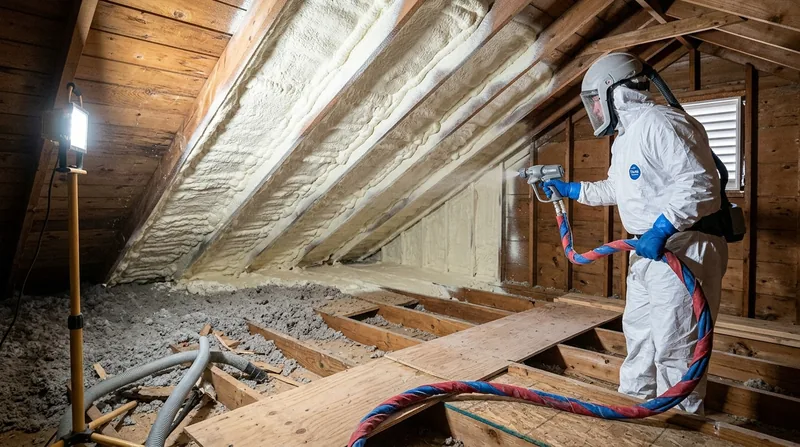




Evansville's older riverfront homes and mid-century ranches carry original fiberglass and blown-in insulation that has settled, compacted, or failed after decades of humid summers and cold winters. When energy bills climb and comfort drops, insulation replacement and re-insulation in Evansville restores R-value to code and seals the air leaks that fiberglass alone cannot fix. We remove the old material, inspect the substrate for moisture and damage, and install spray foam sized for IECC zone 4A, covering Vanderburgh County attics, crawl spaces, rim joists, and wall cavities where that two-way vapor drive between the Ohio River valley and your conditioned space is the engine of energy loss.
Why Insulation Replacement Matters in Evansville's Hot Summers and Damp Winters
Homes across Evansville, Newburgh, and Darmstadt face a climate that drives moisture into walls and attics in summer and reverses that flow in winter. Flattened fiberglass in a mid-century ranch attic loses R-value year after year, while settling blown-in insulation leaves gaps at the rim joist and band board where the floor meets the foundation. That's where the cooling bill spikes each June, and where ice forms on the soffit each January. Replacement with spray foam insulation addresses both the R-value deficit and the air leaks that fiberglass misses.
- Flattened fiberglass and settled blown-in lose R-value and no longer meet zone 4A code requirements.
- Old insulation often harbors dust, debris, and moisture that compromises indoor air quality and energy performance.
- Rim joists, top plates, and band boards left uninsulated in older homes account for 10 to 15 percent of total air leakage.
- Spray foam fills cavities completely, eliminating the thermal bridging and air gaps that fiberglass cannot seal.
- Replacement is the only way to correct a failed attic or crawl space without patching a broken system.
Each of these failure points is addressable in a single project, and the result is lower bills and steadier comfort from basement to attic.
Key info: A 1,400 square-foot ranch in Highland with original settled fiberglass in the attic and uninsulated rim joists typically sees a replacement project that covers 1,200 board feet of foam and takes 2 to 3 days. The cost starts at $2,800 and moves up with attic height, crawl space access, and substrate preparation. See the insulation removal page for details on what comes out before foam goes in.
For detailed guidance on whether your home qualifies for attic spray foam insulation, check the local building department for your zip code. Evansville's energy code is enforced at the city level, and permit requirements vary between 47711, 47630, and other service areas.
How We Replace and Re-Insulate Attics, Crawl Spaces, and Rim Joists in Evansville
Replacement begins with removal of old material, ventilation of the space, and inspection for moisture, mold, and structural damage. If the substrate is wet or contaminated, we fix the moisture source first or we walk away. Once the space is dry and prepped, we apply spray foam in controlled passes, maintaining manufacturer ratio and drum temperature, with mechanical ventilation running during cure. The thickness and R-value are specified in writing before work starts, and re-entry is twenty-four to forty-eight hours after application.
- We remove all old insulation, debris, and fallen material from attics, crawl spaces, and rim joist cavities.
- We inspect joists, beams, and rim board for rot, moisture, and structural integrity before foam application.
- We ventilate the space mechanically during spray and cure to control off-gassing and ensure complete polymerization.
- We apply foam in multiple thin passes to achieve uniform density, thickness, and adhesion without voids or thin spots.
- We document R-value, thickness in inches, and board footage in writing on every estimate and invoice.
- We allow the full cure window before the space is re-entered or occupied, and we provide a written re-entry window.
This step-by-step approach ensures that replacement insulation performs to code and holds its R-value for decades.
Example: A home in Evansville's 47711 zip code with a vented attic and 1,200 square feet of settled R-19 blown-in fiberglass needs to be brought to R-38 for zone 4A. We remove the old material, inspect the decking and rim board, spray 5.5 inches of open-cell foam (R-3.6 per inch) for a total of R-19.8, then add 2 inches of closed-cell foam (R-6.5 per inch) for a total of R-13, reaching R-32.8 combined. The job takes 2 days and costs from $2,800 to $3,600 depending on attic height and access. See open-cell spray foam insulation for more on this hybrid approach.
Insulation Replacement Methods: Spray Foam, Blown-In Top-Up, and Removal
| Approach | Description | Best for |
|---|---|---|
| Full removal and spray foam replacement | Old insulation is removed to the deck, substrate is inspected and prepped, and spray foam is applied to specified thickness and R-value. | Attics with settled or failed fiberglass, crawl spaces with moisture history, rim joists and band boards, sealed roof decks. |
| Blown-in top-up over sound fiberglass | If existing fiberglass is still intact and dry, additional blown-in insulation is added to reach R-38 or R-49 without removal. | Attics with R-19 or R-25 original insulation that is not compacted, and where access and ventilation are adequate. |
| Hybrid: removal, air sealing, and spray foam | Old material is removed, all air leaks at rim joist, top plate, and ductwork are sealed with foam, then open-cell or closed-cell is applied to the attic. | Homes with high cooling or heating bills, moisture in crawl spaces, and rim joist gaps that are the primary source of energy loss. |
| Wall and injection foam retrofit | Closed-cell foam is injected into wall cavities of pre-1980 homes without demolition, filling voids and adding R-value to exterior walls. | Older wood-frame homes with uninsulated or partially insulated wall cavities, especially riverfront and mid-century ranches. |
Each approach is sized to the building, the climate, and the failure mode. The written estimate specifies which method applies and why.
Insulation Replacement and Re-Insulation Cost in Evansville: What to Expect
Replacement projects in Evansville start at $2,800 for a smaller attic or crawl space and climb based on square footage, attic height, rim joist linear feet, moisture remediation, and substrate repair. A full attic replacement on a 1,400 square-foot ranch typically runs $2,800 to $4,200. Crawl space insulation and rim joist sealing on a home with a wet or damp foundation adds time and materials and can push the total to $5,500 or more. Wall injection foam in a pre-1980 home with multiple cavities is quoted on site once we measure the wall area and cavity depth.
- Board footage is the primary cost driver, measured on site and specified in the written estimate before work begins.
- Substrate prep, moisture control, and removal of old material add to labor time and cost.
- Access difficulty, attic height, and crawl space headroom affect crew time and equipment needs.
- Your local building department can tell you what applies at your address.
- Travel to Evansville, Newburgh, Darmstadt, and surrounding areas is included with no separate mileage fee.
The best way to know your cost is a free written estimate. Call (930) 212-3276 for a no-obligation site visit and quote. See the full pricing page for additional details on factors that move the estimate up or down.
Insulation Replacement and Re-Insulation Near Me: What to Look for When Hiring a Spray Foam Contractor in Evansville
Hiring the right contractor for insulation replacement means verifying insurance, understanding the scope of work, and confirming that the estimate includes R-value and thickness. Many contractors in the tri-state run fast jobs with no mechanical ventilation during cure, promise immediate re-entry, and give estimates with no R-value or board footage specified. That is the behavior of a rig-and-run crew, and it is the leading cause of odor complaints and warranty disputes. A local contractor with a local address, local plates, and a verifiable insurance certificate is the baseline. Ask for written estimates from at least two contractors, and check each one for specifics: thickness in inches, R-value per inch, total R-value, board footage, and the re-entry window after cure.
- Confirm that the contractor is fully insured and that coverage details are provided in writing before work starts.
- Request a written estimate that includes R-value, thickness in inches, board footage, and the type of foam (open-cell or closed-cell).
- Ask whether old insulation removal, substrate inspection, and moisture assessment are included in the estimate or are add-ons.
- Verify that mechanical ventilation will run during spray and cure, and confirm the re-entry window in writing.
- Check references from recent projects in Evansville or nearby areas, and ask about odor, cure time, and follow-up service.
- Confirm that your local building department's permit requirements are understood and that the contractor will work with the inspector.
Once you have selected a contractor, contact us or call (930) 212-3276 to schedule your free estimate and discuss your specific insulation replacement needs. We serve Evansville, Newburgh, Chandler, Highland, Darmstadt, Boonville, and the surrounding counties with the same standards every time: written estimates with R-value and thickness, mechanical ventilation during cure, and a workmanship warranty that covers the installation for one year.
Insulation Replacement & Re-Insulation in Evansville: Pricing Guide
| Service | Price | Details |
|---|---|---|
| Attic replacement (1,000 to 1,500 sq ft) | Starting at $2,800 | Includes removal, inspection, and spray foam to R-38 or R-49 depending on zone 4A requirement and attic height |
| Crawl space and rim joist sealing | Starting at $3,200 | Includes removal of old insulation, moisture assessment, foam application to walls and band board, and thermal barrier installation |
| Wall and injection foam retrofit | Starting at $4,500 | Closed-cell foam injected into cavities of pre-1980 wood-frame homes without demolition, priced per wall area and cavity depth |
| Hybrid attic and rim joist project | Starting at $4,200 | Full attic replacement plus complete rim joist and band board sealing on a single-story or ranch-style home |
| Estimate and site visit | Free | Written estimate within 24 hours with R-value, thickness, board footage, and all factors affecting final cost specified |
Indicative pricing, the exact cost depends on square footage, finish, and site access. Free personalized estimate within 24h at (930) 212-3276.


