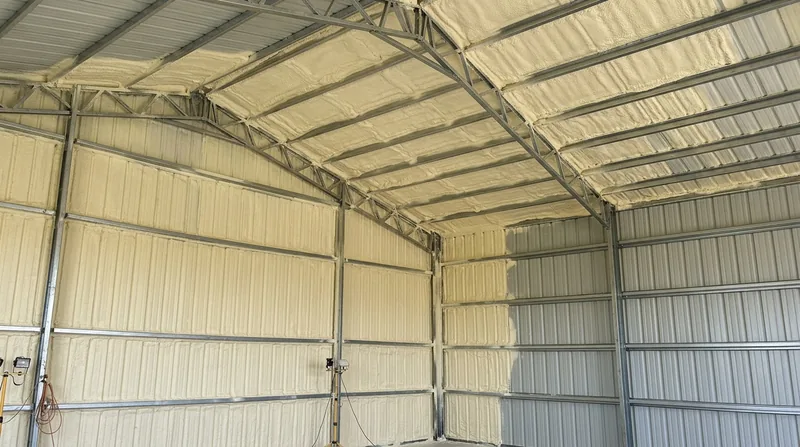




Metal building and barndominium spray foam insulation in Evansville stops condensation before it starts. Metal structures across Gibson and Posey counties face a brutal seasonal cycle: hot, humid summers drive moisture inward through the steel skin, and cold winters reverse that vapor drive, leaving interior surfaces sweating and dripping. A single-skin metal building or barndominium without foam insulation becomes a condensation machine. We spray closed cell foam directly to the metal roof and walls to create an air-sealed, moisture-blocking thermal barrier that keeps interior temperatures steady and eliminates the rust, mold, and corrosion that follow. This is not a cosmetic upgrade. It is the difference between a usable space and a wet box that destroys equipment and finishes.
Why Metal Building Condensation Is the Real Problem in Evansville
Evansville sits in IECC climate zone 4A, mixed humid, with hot, humid summers and cold winters in the same year. Metal buildings have no thermal mass. In summer, outside air at 90 degrees and 80 percent humidity pushes moisture vapor through any gap or joint. In winter, that pattern flips: warm interior air meets cold metal skin and condenses instantly. Unlike a wood-frame attic, a metal building interior has nowhere for that moisture to go. It pools on equipment, rusts fasteners, and rots any wood framing or insulation underneath. Spray foam stops that two-way vapor drive at the source.
- We spray closed cell foam directly to the metal skin to create a continuous moisture barrier with no seams or gaps.
- The foam adheres to steel and aluminum, bonding the insulation to the structure so it cannot settle or separate.
- Proper thickness (typically 3.5 to 5.5 inches for closed cell) delivers R-values of 21 to 33 and stops condensation completely.
- The air seal prevents humid outside air from entering the structure during summer and warm interior air from reaching cold metal in winter.
A metal building sprayed with closed cell foam stays dry year-round, and the equipment inside lasts twice as long.
Local example: A 40-by-60-foot steel hay shed in Newburgh spent three years with rust streaks running down the interior walls and equipment corroding in the corners. After a single spray foam application to the roof deck and walls, the condensation stopped within 48 hours. No more rust, no more mold smell, and the interior stayed 15 degrees warmer in winter.
Indiana's building code and the International Energy Conservation Code (IECC) govern insulation requirements for metal buildings, and the local building department in your city has the final say on thickness, thermal barrier requirements, and any permits your specific structure requires. Always check with your city or county building official before work begins. For reference, you can review the Indiana Department of Natural Resources energy efficiency resources for state-level guidance.
How We Spray Metal Buildings and Barndominiums in Evansville
Every metal building job starts with a walk-through to assess the roof deck condition, interior layout, and any existing insulation or obstructions. We check for rust, leaks, or moisture already present. If the substrate is wet or contaminated, we walk away and recommend fixing the moisture problem first. Once the structure is dry and ready, we stage equipment, set up ventilation, and spray the foam in controlled passes directly to the metal skin. Closed cell foam bonds instantly and cures hard, so re-entry and interior finishing can begin within 24 to 48 hours depending on thickness and ambient temperature.
- We inspect the metal roof and wall condition and verify that the substrate is dry before any foam application.
- We set up mechanical ventilation to manage off-gassing during the cure period and establish a clear re-entry timeline.
- We spray closed cell foam in multiple thin passes to achieve the specified thickness and R-value without over-application.
- We seal all seams, joints, and penetrations (electrical, HVAC, door frames) with foam or compatible sealant to eliminate air leakage paths.
- We verify the final thickness and R-value with a written estimate and on-site documentation before work closes.
The result is an air-sealed, moisture-proof thermal envelope that performs year-round and requires no maintenance.
Real job: A 30-by-50-foot barndominium conversion in Highland required 5.5 inches of closed cell foam to meet the local code R-value requirement of 30. We sprayed the entire roof deck and upper sidewalls, sealed the rim band where the structure met the concrete pad, and finished in two days. The owner reported that interior temperatures stabilized within a week and the smell cleared within 48 hours of re-entry.
For more detail on how we handle air sealing around foam applications, see our air sealing service page.
Metal Building Insulation Methods
| Approach | Description | Best for |
|---|---|---|
| Closed Cell Foam to Metal Skin | Direct adhesion to roof deck and walls, 3.5 to 5.5 inches, R-21 to R-33, complete air seal and moisture barrier. | Metal buildings and barndominiums in humid climates where condensation control is the priority. |
| Closed Cell Foam with Cavity Fill | Foam sprayed into existing stud bays or metal stud cavities, fills voids completely, stops air infiltration at framing. | Retrofits of older metal buildings with internal framing or hybrid wood-and-steel construction. |
| Insulation Removal and Replacement | Old fiberglass or failed foam removed and disposed, substrate cleaned and prepped, new closed cell foam applied. | Metal buildings with deteriorated or ineffective existing insulation that need a fresh thermal and moisture barrier. |
| Sealed Attic or Roof Deck Conversion | Foam applied to underside of metal roof decking to create a conditioned attic or loft space, full R-value and air seal. | Barndominiums and metal buildings converted to living or storage space where interior climate control is essential. |
Metal Building and Barndominium Spray Foam Cost in Evansville: What to Expect
Metal building spray foam pricing depends on roof area, wall coverage, foam thickness, and substrate condition. A straightforward application of closed cell foam to a metal roof or wall typically starts at $1.75 per square foot, but the final cost reflects the R-value specification your building code requires, any prep work needed to clean or repair the substrate, and the complexity of the site layout. A 2,000-square-foot metal building roof might run $3,500 to $5,000 for a complete spray application with proper thickness and air sealing. A larger structure or one that includes both roof and wall coverage will cost more. Travel is included within Evansville and surrounding areas, so there is no separate mileage charge.
The best way to get an accurate number is to request a free written estimate. We measure the structure on site, verify the substrate condition, confirm the R-value and thickness required by your local building code, and provide a firm quote with specifications. Most estimates are ready within 24 hours, and there is no obligation to book. Call (930) 212-3276 or visit our pricing page for more detail on what moves the cost up or down.
Metal Building and Barndominium Spray Foam Near Me: What Evansville Homeowners Should Know
Hiring a spray foam contractor is a significant decision, and the wrong choice can leave you with a smell that will not go away, poor adhesion, or inadequate R-value. The trade has rig-and-run crews that spray a job in an afternoon and disappear, and it has national franchises with high overhead and inconsistent crews. The local independent contractor with a verifiable track record and full insurance is the safest bet. Before you commit, verify that any contractor you call is fully insured with a certificate of insurance you can review. Ask for references from jobs completed in the past 12 months, and call at least two of them to ask about cure smell, interior temperature change, and whether the contractor was reachable if questions came up after the work was done.
Get written estimates from at least two contractors. A proper estimate includes the R-value you are targeting, the foam thickness in inches, the total board feet of foam, the cost per square foot or per board foot, and the cure and re-entry timeline. If an estimate has no R-value and no thickness, and the price is far below market, walk away. Confirm that the contractor carries liability insurance and that the policy covers spray foam application. Ask whether any permits are required for your specific building and location. HOA architectural rules rarely touch insulation work, but if your metal building is in a master-planned community, check the covenants before you start. Your city or county building department can tell you whether a permit is required for spray foam insulation on your structure.
For a free, no-obligation estimate and references from recent jobs in Evansville, Newburgh, Chandler, Highland, and surrounding areas, contact us today.
Metal Building & Barndominium Spray Foam in Evansville: Pricing Guide
| Service | Price | Details |
|---|---|---|
| Metal building roof (closed cell foam) | Starting at $1.75/sq ft | Direct spray to metal deck, 3.5 to 5.5 inches, includes air sealing and moisture barrier application |
| Metal building walls and gable ends | Starting at $1.75/sq ft | Closed cell foam to exterior or interior walls, full coverage, thickness per local code R-value requirement |
| Hybrid roof and wall coverage | Starting at $1.75/sq ft | Roof deck plus wall application, sealed rim band and all penetrations, price reflects total square footage |
| Insulation removal and replacement | On estimate | Old foam or fiberglass removed, substrate cleaned and prepped, new closed cell foam applied, cost depends on existing material volume |
| Travel and estimate | Free | No mileage fee within Evansville and surrounding service areas, written estimate within 24 hours at (930) 212-3276 |
Indicative pricing, the exact cost depends on square footage, finish, and site access. Free personalized estimate within 24h at (930) 212-3276.


