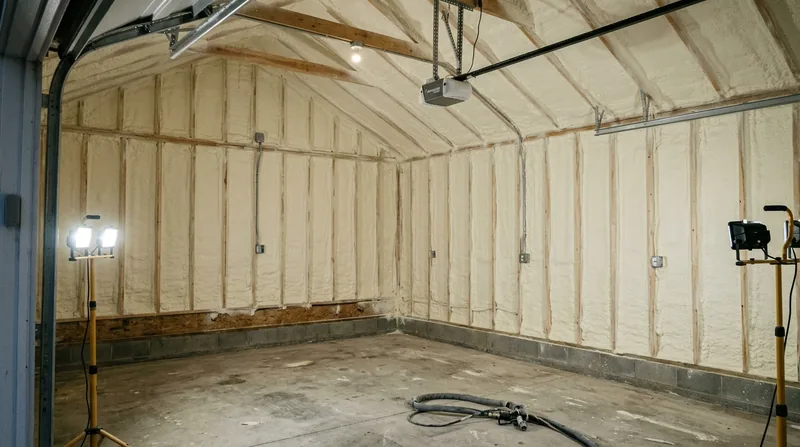




Garage spray foam insulation in Evansville transforms a space that swings between summer heat and winter cold into a usable workshop, bonus room, or storage area year-round. Garages across Vanderburgh County face the same two-way vapor drive that plagues attics and crawl spaces: humid outside air pushes moisture inward in summer, and that pattern reverses in winter, leaving walls and ceilings exposed to temperature swings of 40 to 60 degrees between seasons. A garage without insulation becomes a thermal sieve, driving up the cost of conditioning the living space directly above it and making any work done inside uncomfortable most of the year. Spray foam seals the walls and ceiling in a single pass, stops that moisture infiltration at the source, and creates a conditioned envelope that holds temperature and humidity steady. We have been insulating garages, bonus rooms, and metal-frame shops across the tri-state since 2013, and we know exactly how Evansville's climate and building stock demand this work.
Why Garage Spray Foam Insulation Matters in Evansville's Climate
Evansville sits in IECC climate zone 4A, mixed humid, where summer temperatures climb into the 80s and 90s with high humidity, and winter cold snaps dip below freezing for weeks at a time. Garages are the first place that thermal gradient shows up: uninsulated walls radiate heat outward in winter and let hot, humid air pour in during summer. If you have a bonus room, finished space, or heated workshop over the garage, that temperature swing in the garage below forces your HVAC system to work harder just to maintain comfort upstairs. Moisture that enters through uninsulated walls during humid months can migrate into the rim joist, band joist, and the top plate of the garage structure itself, creating long-term durability problems that are far more expensive to fix than insulation.
- Spray foam stops outside air from entering through garage walls and ceiling, cutting the thermal load on the space above.
- A sealed garage ceiling prevents humid summer air from migrating into the attic space and condensing on cool surfaces in winter.
- Closed-cell foam applied to the rim joist and top plate protects the structural wood from the moisture swings that dominate this region.
- Open-cell foam in the garage walls provides excellent insulation at a lower cost if moisture control is not the primary concern.
The payoff is a garage that stays closer to outdoor temperature but does not swing as wildly, protecting both the space and the structure around it.
Key info: A typical two-car garage in Evansville or Newburgh loses more heat through uninsulated walls and ceiling than through the door itself. Spray foam applied to just the walls and ceiling can cut that loss by 60 to 70 percent, and the foam acts as an air seal so infiltration stops, not just slows.
How We Spray Foam a Garage in Evansville: The Process
Garage spray foam insulation starts with a clear assessment of what needs to be sealed. We look at the existing condition of the walls, the ceiling, the rim joist at the band between the garage and the house, and the door frame. Some garages have partial insulation or old fiberglass batts that have settled; others are bare studs with no thermal barrier at all. We walk through the space with the homeowner, explain what we will seal and why, and discuss whether closed-cell or open-cell foam is the right fit for the use case. Once you approve the scope, we prepare the space, set up ventilation for the spray operation, and apply the foam in controlled passes to the specified thickness and density.
- We inspect the garage walls, ceiling, rim joist, and door frame to identify all air leakage paths and thermal weak points.
- We discuss the choice between closed-cell foam for maximum R-value and moisture resistance, or open-cell foam for cost-effective coverage and sound dampening.
- We protect or remove items from the spray zone and set up mechanical ventilation to manage fumes during the application.
- We apply foam in multiple thin passes to reach the specified thickness, allowing each pass to cure before the next layer is added.
- We observe a re-entry window of 24 to 48 hours before the space is used, allowing the foam to fully cure and off-gas.
The result is an airtight, thermally continuous garage envelope that holds temperature and keeps moisture from infiltrating the structure.
Real example: A ranch home in Highland with a bonus room over a two-car garage had the garage walls and ceiling sprayed with open-cell foam to R-15. The homeowner reported that the bonus room stayed 8 to 12 degrees warmer in winter and did not overheat as quickly in summer. The garage itself became usable as a workshop year-round without space heating.
Spray Foam Methods for Garage Insulation
| Approach | Description | Best for |
|---|---|---|
| Open-Cell Spray Foam | Low-density foam that expands and fills cavities; lower R-value per inch but excellent air sealing and sound dampening. | Garage walls and ceilings where cost efficiency and noise reduction matter; acceptable moisture permeability for vented spaces. |
| Closed-Cell Spray Foam | High-density foam with closed cells; higher R-value per inch and vapor-impermeable; resists moisture infiltration. | Rim joists, band joists, and garage ceilings where moisture control and maximum R-value in thin depth are priorities. |
| Partial Garage Spray | Foam applied only to the ceiling and rim joist, leaving walls bare or with existing insulation; lower cost, targeted approach. | Garages with tight budgets or where the primary heat loss is through the ceiling and top of the walls. |
| Full Garage Enclosure | Walls, ceiling, door frame, and rim joist all sprayed to create a fully conditioned and sealed envelope. | Bonus rooms over garages, heated workshops, and spaces where year-round comfort and structural protection are essential. |
Garage Spray Foam Insulation Cost in Evansville: What to Expect
Garage spray foam insulation in Evansville typically starts at $1,200 for a basic two-car garage with partial coverage (ceiling and rim joist only) and open-cell foam. A full-coverage job with closed-cell foam on walls, ceiling, and rim joist usually runs between $2,500 and $4,500, depending on the garage size, the type of foam chosen, and how much existing insulation needs to be removed first. Bonus rooms and heated workshops over garages often run higher because the foam must meet code thermal barrier requirements and the application is more detailed. The single biggest cost driver is whether you are starting with bare studs or removing failed insulation first. Access also matters: a garage with a low ceiling or tight framing takes longer to spray safely and will cost more than one with clear, open walls. We provide a written estimate with R-value and thickness specifications so you know exactly what you are paying for and why.
To get an accurate price, we need to see the garage in person. Factors that affect the final number include the square footage of walls and ceiling, the height of the space, whether the rim joist is exposed or buried in rim board, and whether we are spraying over existing insulation or bare studs. If you are insulating a bonus room over the garage, code compliance for thermal barriers and ignition barriers will also be part of the scope. We recommend getting 2 to 3 estimates so you can compare not just price but also the R-value and thickness each contractor specifies. A suspiciously low estimate with no R-value and no thickness spec is a red flag; so is a promise of immediate re-entry or a price that seems far below market. Visit our pricing page to see the full range of service costs and what drives them.
Garage Spray Foam Insulation Near Me: What to Look for When Hiring a Contractor in Evansville
Hiring a spray foam contractor in Evansville or Newburgh requires the same due diligence you would apply to any skilled trade. Start by verifying that the contractor is fully insured; ask to see the certificate of insurance and confirm that it covers spray foam application and the specific work you are requesting. Get a written estimate that includes the R-value, the foam thickness in inches, the type of foam (open-cell or closed-cell), and the total square footage being covered. Do not accept an estimate without these details, and do not accept a price that is far below market with no explanation. Check references from recent jobs in Evansville, Darmstadt, or Newburgh; a good contractor will provide names of homeowners who can speak to the quality of the work and how the space has performed since the foam was applied.
Understand what permits apply at your address. Spray foam work in Evansville may require a building permit depending on the scope and the city or county jurisdiction. The local building department will tell you what is required; we help homeowners navigate what applies at their address and what the building official will need to inspect. If your garage is part of an HOA community, check the architectural guidelines to confirm that spray foam insulation on the garage walls or exterior is permitted; most HOAs do not restrict insulation, but some do govern exterior finishes. Ask about the cure time and re-entry window: honest contractors will tell you that the space should not be used for 24 to 48 hours after the foam is applied, allowing it to fully cure and off-gas. If a contractor promises immediate re-entry or says the smell will be gone by tomorrow, find another contractor. Call us at (930) 212-3276 to discuss your garage and get a free, no-obligation estimate, or visit our contact page to request a time that works for you.
Spray foam insulation is a long-term investment in comfort, efficiency, and structural durability. In Evansville's hot, humid summers and cold winters, a properly insulated garage protects not just the space itself but also the living areas above it and the integrity of the wood framing around it. We have been doing this work since 2013, and we know the local climate and building stock inside and out. If you are ready to stop losing comfort and energy dollars through an uninsulated garage, call us at (930) 212-3276 or visit our homepage to learn more about how spray foam can transform your space.
Garage Spray Foam Insulation in Evansville: Pricing Guide
| Service | Price | Details |
|---|---|---|
| Partial Garage Spray (Ceiling & Rim Joist) | Starting at $1,200 | Open-cell foam on ceiling and rim joist; typical two-car garage, includes site prep and cleanup |
| Full Garage Enclosure (Walls, Ceiling & Rim) | Starting at $2,500 | Complete coverage with open-cell or closed-cell foam; size, access, and existing insulation removal affect final price |
| Bonus Room or Heated Workshop Over Garage | Starting at $3,200 | Full enclosure plus code-compliant thermal and ignition barriers; higher complexity and square footage drive higher cost |
| Insulation Removal Before Spray | On estimate | Removal of failed foam, fiberglass batts, or other insulation before new spray application; scope and disposal add to overall project cost |
| Travel | Included | No separate travel fee or mileage charge within Evansville and surrounding service areas |
| Free Estimate | No cost | Written estimate with R-value and thickness specs; response within 24 hours, no obligation to book |
Indicative pricing, the exact cost depends on square footage, finish, and site access. Free personalized estimate within 24h at (930) 212-3276.


