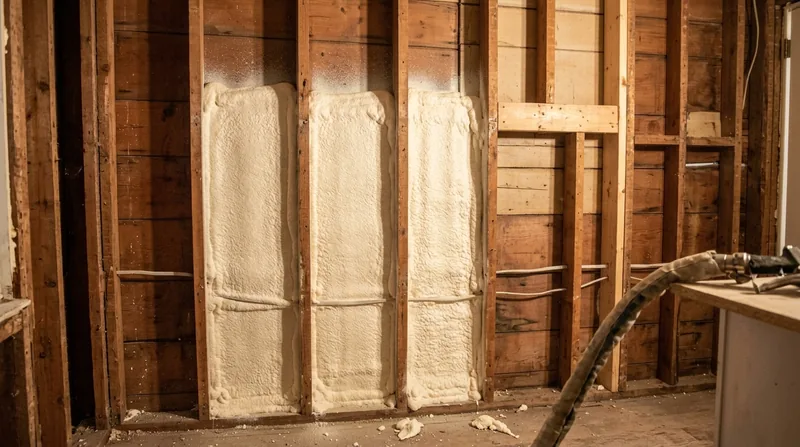




Closed cell spray foam insulation in Evansville delivers rigid, moisture-resistant protection where humidity and seasonal temperature swings push hardest against your walls and foundation. On the Ohio River in Evansville's mixed humid climate, older wood-frame homes near Haynie's Corner and mid-century ranches across Vanderburgh County face a two-way vapor drive: in summer, humid outside air pushes moisture inward through rim joists and crawl space walls; in winter, that pattern reverses, and basements stay damp after rain no matter the season. Closed cell foam holds its R-value even when ground moisture and flood-prone conditions test the envelope from below. Unlike open cell foam or blown-in fiberglass, closed cell creates an air and moisture barrier in a single application, making it the right answer for retrofit wall cavities, crawl spaces, and rim joists where moisture control matters as much as insulation. We help homeowners and builders in Evansville, Newburgh, Chandler, and surrounding areas choose closed cell when the job demands it, and we say plainly when a different product is the smarter choice.
Why Closed Cell Spray Foam Matters in Evansville's Humid Climate
Evansville sits in IECC climate zone 4A with hot, humid summers and cold winters in the same house. The Ohio River and flood-prone ground water push moisture into crawl spaces and basement walls year-round. Mid-century ranches and older wood-frame homes with original cavities and uninsulated rim joists are especially vulnerable: fiberglass absorbs moisture and loses R-value, and foam that cures without proper ventilation or at the wrong thickness can trap moisture and fail. Closed cell foam resists water absorption, maintains its R-value in damp conditions, and provides the rigid structural support that matters when a wall cavity or rim joist is under load.
- Closed cell foam resists moisture absorption and stays effective even when crawl space humidity or seasonal flooding pushes water vapor into the wall cavity.
- The rigid cellular structure adds bracing strength to old wood-frame walls and rim joists, preventing flex and racking that can crack drywall or damage framing.
- Closed cell delivers higher R-value per inch (typically R-6.0 to R-6.5) than open cell, so it fits tight attic spaces and shallow rim joist cavities without adding bulk.
- When installed to the correct thickness with proper cure ventilation, closed cell creates a complete air seal that stops infiltration and the energy loss that drives summer cooling bills and winter heating costs.
Getting closed cell right means controlling the spray ratio, drum temperature, pass thickness, and cure environment so the foam cures fully and stays bonded to the substrate.
Key info: A 1980s ranch in Highland with an uninsulated rim joist and a damp crawl space space can lose 15 to 25 percent of its heating and cooling energy through that single thermal bridge. Closed cell foam seals the rim joist and resists the moisture that would degrade fiberglass in the same location.
For more on how moisture affects insulation performance in crawl spaces, see our crawl space spray foam insulation page. The Indiana Building Code and local city building departments govern insulation thickness, thermal barriers, and ignition barriers. Always verify what applies at your address with your local building official before work begins.
How We Install Closed Cell Spray Foam in Evansville
Closed cell spray foam is applied in controlled passes, each typically 1 to 2 inches thick, building up to the target R-value and thickness specified on the estimate. The substrate must be dry, clean, and free of loose debris; if a crawl space is wet or a wall cavity has active moisture, we address that first or we walk away. Once sprayed, the foam expands and cures. Proper mechanical ventilation during cure prevents odor buildup and allows isocyanate vapors to exit the space safely. We specify a re-entry window of 24 to 48 hours depending on temperature and humidity, and we communicate that clearly so homeowners know when the space is ready to use again.
- We inspect the substrate and verify it is dry; if standing water, active seepage, or moisture damage is present, we defer the foam application and recommend remediation first.
- We mask and protect areas outside the spray zone so overspray does not contaminate finished surfaces or mechanical equipment.
- We apply closed cell in sequential passes at the manufacturer-specified ratio, drum temperature, and pressure, checking thickness and coverage as we go.
- We install mechanical ventilation (fans or open windows) during cure to manage isocyanate vapor and control odor, and we post a re-entry notice with the safe timeframe.
- Once cured, we trim excess foam flush with framing and apply the thermal barrier (drywall, intumescent paint, or other code-approved material) if required by the building code at your address.
Every estimate includes R-value and thickness specifications, so you know exactly what you are paying for and what the code requires.
Example: A 1950s home in Evansville near the riverfront has original 2x4 exterior walls with no cavity insulation and a damp crawl space. We remove the old insulation, seal and dry the rim joist and band board, then apply 2.5 inches of closed cell foam (R-15 to R-16) to the rim and 1.5 inches to the band board. Mechanical ventilation runs during cure, and the homeowner can re-enter the crawl space 36 hours after application.
For retrofit wall cavities in older homes, see our page on wall and injection foam insulation. For attics with higher moisture risk or where you want both air sealing and structural support, attic spray foam insulation may be the better fit.
Closed Cell Spray Foam Methods and Applications
| Application | Description | Best For |
|---|---|---|
| Rim and band joist sealing | Closed cell foam applied to the band board and rim joist cavity, typically 1.5 to 2.5 inches thick, creating a continuous thermal and air barrier at the foundation-to-framing transition. | Mid-century ranches and older homes with uninsulated or deteriorated rim joists; stops infiltration and moisture intrusion where the house meets the foundation. |
| Crawl space wall insulation | Closed cell applied to the interior or exterior of crawl space walls, 1.5 to 3 inches thick, resisting moisture absorption and maintaining R-value in high-humidity or flood-prone conditions. | Crawl spaces with persistent moisture from groundwater, seasonal flooding, or humid outdoor air; prevents fiberglass degradation and condensation on metal beams. |
| Retrofit wall cavity fill | Closed cell injected into existing wall cavities of older wood-frame homes, 3 to 5.5 inches thick, without removing drywall or siding, adding R-value and air sealing in one pass. | Pre-1980 homes in Evansville with original empty cavities; avoids full-wall demolition while adding insulation and air sealing to exterior walls. |
| Metal building and sealed attic decks | Closed cell applied to the underside of metal roof decks or attic sheathing, 2 to 4 inches thick, controlling condensation and providing structural bracing on steel framing. | Barndominiums, metal buildings, and sealed attic assemblies where condensation on steel is a risk; adds rigidity and prevents moisture damage to equipment stored below. |
| Attic air sealing and insulation | Closed cell sprayed over attic rim joists, top plates, and mechanical penetrations before blown-in cellulose or fiberglass, or used as the primary insulation in tight attics where depth is limited. | Bonus rooms, cathedral ceilings, and attics with complex framing; seals air leaks that fiberglass cannot and provides a moisture-resistant base layer. |
Closed Cell Spray Foam Insulation Cost in Evansville: What to Expect
Closed cell spray foam typically starts at around $1.20 per board foot, though the final cost depends on the scope of work, substrate condition, access, and how much foam you need to reach your target R-value. A rim joist job on a single-story ranch in Evansville might run $800 to $1,500; a full crawl space or a retrofit wall cavity in a two-story home could easily reach $2,500 to $5,000 or more. The best way to understand what a job will cost is to get a written estimate with R-value and thickness specifications, not a vague per-board-foot quote with no details.
- Substrate condition affects cost: a dry, clean rim joist takes less time than one requiring moisture remediation or debris removal.
- Access and working height matter: a crawl space 3 feet tall costs less to spray than a vaulted attic 30 feet up, which requires lifts or scaffolding.
- Thickness and R-value are set by code and your heating and cooling needs; thicker foam (3 to 5.5 inches) costs more than thin applications (1.5 to 2 inches).
- Travel is included in Evansville and surrounding areas; we do not charge a separate mileage fee.
- The estimate is free and comes within 24 hours at (930) 212-3276; we measure on site and give you a firm number based on what the job actually requires.
For a detailed pricing breakdown and examples of typical jobs, see our full pricing page. We also handle insulation removal and replacement, which often precedes a closed cell retrofit; removing failed fiberglass or old foam adds cost but is necessary to ensure the new foam bonds properly to a clean substrate.
What to Look for When Hiring a Spray Foam Insulation Contractor Near Evansville
Hiring the right spray foam contractor matters because the work is invisible once it cures, and a bad installation (wrong ratio, poor ventilation, no thickness spec, immediate re-entry promised) can trap moisture, cause odor, or fail to deliver the R-value you paid for. Verify that any contractor you call is fully insured and can provide a certificate of insurance. Ask for an estimate in writing with R-value, thickness, and substrate preparation spelled out. Check references from recent jobs in Evansville or nearby towns. If your home is in an HOA, verify that exterior work on metal buildings or sealed attics meets architectural guidelines. Always defer to your local building department on permit requirements; the City of Evansville and towns across Vanderburgh, Gibson, Posey, and surrounding counties have different codes and inspection rules.
- Request a written estimate with R-value per inch, total thickness in inches, square footage or board footage, and the substrate preparation plan.
- Ask how the contractor will manage ventilation during cure and what re-entry window they recommend (24 to 48 hours is standard).
- Verify insurance coverage with a certificate of insurance naming your address as an additional insured if required by your lender or HOA.
- Call at least two other contractors and compare estimates; if one is drastically cheaper with no detail, that is a red flag.
- Check with your local building department to confirm what permits and inspections apply at your address before work starts.
A local contractor with a local address and local plates is positioned to stand behind the work and be reachable if questions arise after installation. Ready to get started? Contact us for a free estimate or call (930) 212-3276 today.
Closed Cell Spray Foam Insulation in Evansville: Pricing Guide
| Service | Price | Details |
|---|---|---|
| Rim and band joist sealing | Starting at $1.20/board ft | 1.5 to 2.5 inches of closed cell foam applied to rim joist and band board, includes substrate prep and air sealing at the foundation transition |
| Crawl space wall insulation | Starting at $1.20/board ft | Closed cell applied to crawl space walls, 1.5 to 3 inches thick, resisting moisture and maintaining R-value in damp conditions; cost increases with wall height and moisture remediation |
| Retrofit wall cavity fill | Starting at $1.20/board ft | Injection foam into existing wall cavities without demolition, 3 to 5.5 inches thick; cost depends on cavity depth, wall length, and access for drilling and injection ports |
| Metal building or sealed attic deck | Starting at $1.20/board ft | Closed cell applied to metal roof decks or attic sheathing, 2 to 4 inches thick; pricing includes access equipment and condensation control on steel framing |
| Estimate and travel | Free | Written estimate with R-value and thickness specs within 24 hours; travel included in Evansville and surrounding service areas, no mileage fee |
Indicative pricing, the exact cost depends on square footage, finish, and site access. Free personalized estimate within 24h at (930) 212-3276.


