Why Attic Insulation Flattens Over Time
If you own a mid-century ranch home in Evansville, you've likely noticed that your attic insulation doesn't perform the way it used to. Over decades, traditional blown-in insulation settles, compacts, and loses its effectiveness. This isn't a defect in your home; it's simply what happens when insulation materials are exposed to decades of temperature fluctuations, moisture, and gravity.
Blown-in insulation like fiberglass or cellulose relies on air pockets trapped within the material to provide its R-value. As these materials age, they absorb moisture from seasonal humidity changes, settle under their own weight, and compress in high-traffic attic areas. By the time your home reaches 40 or 50 years old, you may have lost 20 to 40 percent of your original insulation's effectiveness. This explains why your heating and cooling bills keep climbing, even though you haven't changed your habits.
Spray Foam vs Blown In Insulation: A Side-by-Side Comparison
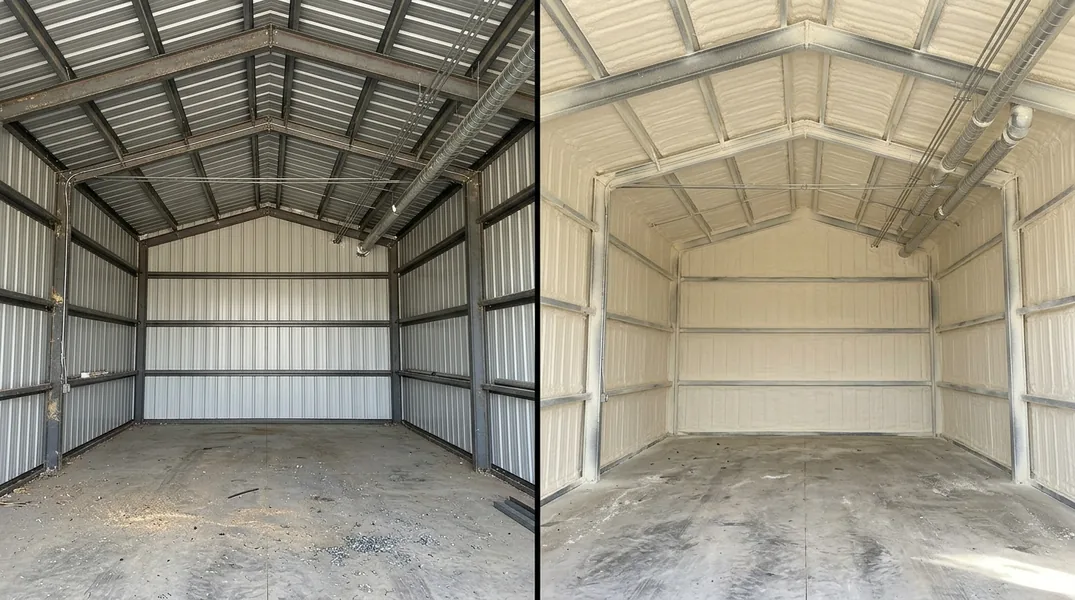
Attic Spray Foam Insulation fundamentally differs from traditional blown-in materials in how it works and how long it lasts. When you compare spray foam vs blown in insulation, the most obvious difference is application method. Blown-in insulation is loosely distributed across your attic floor, while spray foam is applied as a liquid that expands and hardens into a solid, continuous barrier. This difference in application creates dramatically different performance outcomes.
Blown-in insulation, whether fiberglass or cellulose, relies on uniform coverage and consistent density to maintain its R-value. Any settling, compression, or moisture absorption reduces performance. Spray foam, by contrast, adheres to every surface, seals gaps and cracks, and maintains its structural integrity indefinitely. It doesn't settle, doesn't compress, and doesn't lose R-value over time. When homeowners in Evansville upgrade from flattened blown-in insulation to spray foam, they typically see energy savings of 15 to 30 percent within the first heating season.
Spray Foam vs Fiberglass: Why Fiberglass Falls Behind
Fiberglass has been the standard attic insulation for generations, and for good reason. It's affordable, easy to install, and provides decent thermal resistance when new. However, fiberglass has significant limitations that become apparent over time. Fiberglass batts and blown-in fiberglass both absorb moisture readily, which reduces their R-value and can lead to mold growth and wood rot in your attic structure. Additionally, fiberglass provides almost no air sealing benefit. Your attic can have excellent fiberglass coverage but still suffer from massive heat loss through air leaks around penetrations, ductwork, and structural gaps.
When comparing spray foam vs fiberglass, the longevity advantage strongly favors spray foam. Fiberglass typically lasts 15 to 20 years before significant degradation occurs. Spray foam, particularly Closed Cell Spray Foam Insulation, can last 50 to 80 years with virtually no loss of R-value. Fiberglass also requires regular maintenance and eventual replacement. Spray foam requires no maintenance and won't need replacement for decades. For mid-century homes that have already had their original fiberglass replaced once or twice, spray foam offers a permanent solution.
Best Insulation for Attic: Why Spray Foam Wins for Evansville Homes
When you're researching the best insulation for attic applications, you'll encounter several contenders: fiberglass, cellulose, mineral wool, and spray foam. Each has merits, but spray foam consistently outperforms alternatives in real-world conditions, particularly in older homes with complex attic structures. The best insulation for attic isn't just about R-value per inch; it's about durability, air sealing, moisture resistance, and long-term performance. Spray foam excels in all these categories.
Open Cell Spray Foam Insulation is ideal for attics where you want excellent thermal performance with some vapor permeability, allowing your attic to breathe while still providing superior insulation. Closed cell spray foam offers the highest R-value per inch and provides complete moisture barriers, making it perfect for attics in humid climates or homes with past moisture issues. Both types dramatically outperform traditional blown-in insulation in terms of air sealing, which is often the biggest source of energy loss in older homes. Many homeowners are surprised to learn that air leakage accounts for 30 to 40 percent of total heating and cooling loss in poorly sealed attics.
Spray Foam vs Cellulose: Understanding the Trade-offs
Cellulose insulation has gained popularity as an eco-friendly alternative to fiberglass. It's made from recycled paper, treated with fire retardants, and offers decent R-value for the cost. When comparing spray foam vs cellulose, homeowners often focus on environmental impact and initial expense. Cellulose is cheaper upfront and uses recycled materials, which appeals to environmentally conscious buyers. However, cellulose has critical weaknesses that become apparent in real-world use, especially in attics that experience seasonal humidity changes.
Cellulose readily absorbs and releases moisture, which can lead to mold growth, settling, and performance degradation over time. It also requires denser packing than blown-in fiberglass, which increases installation costs and complexity. Perhaps most importantly, cellulose provides no air sealing benefit whatsoever. Your attic could be packed solid with cellulose and still lose tremendous amounts of conditioned air through gaps and penetrations. Spray foam addresses all these limitations. It's moisture-resistant, never settles, and provides complete air sealing. While spray foam costs more initially, the energy savings, durability, and performance justify the investment over the 50-year lifespan of the material.
Attic Spray Foam Insulation Cost in Evansville: What to Budget
Budget is a legitimate concern for any home improvement project. Spray foam insulation typically costs more per square foot than blown-in alternatives, ranging from $1.50 to $3.50 per board foot depending on foam type, attic accessibility, and project complexity. For a typical 1,500-square-foot attic, you can expect to invest between $3,000 and $8,000 for professional spray foam installation. This higher upfront cost concerns many homeowners, but the long-term economics strongly favor spray foam. Energy savings typically recover your investment within 5 to 7 years, after which you're saving money for decades.
When evaluating pricing for attic spray foam, remember that you're not just paying for insulation. You're paying for air sealing, moisture protection, structural support, and a permanent solution that won't need replacement. Blown-in insulation that costs $1,000 today might need replacement in 15 years for another $1,500. Spray foam installed today will still be performing optimally in 2074. For homeowners in Evansville seeking genuine long-term value and comfort, spray foam is the best insulation for attic applications. Contact Evansville Spray Foam Insulation at (930) 212-3276 to discuss your attic upgrade and get a free estimate tailored to your home's specific needs.
Looking for a professional spray foam insulation contractor in Evansville? Evansville Spray Foam Insulation responds fast for all your spray foam insulation needs.
Get a Free Quote